za-choeje-rinpoche-awareness

ZaChoeje Rinpoche's Lineage

ZaChoeje Rinpoche’s lineage is a direct continuation of an unbroken line of enlightened masters reaching back to Shakyamuni Buddha.

Rinpochelineage

An Unbroken Lineage

ZaChoeje Rinpoche’s lineage is a direct continuation of an unbroken line of enlightened masters reaching back to Shakyamuni Buddha, the historical Buddha who lived and taught over 2,700 years ago. This sacred lineage has been preserved through generations of realized masters who transmitted the essence of Buddha’s wisdom and compassion from master to disciple. ZaChoeje Rinpoche belongs to the Gelug tradition, founded by Je Tsongkhapa, the great 14th-century reformer and scholar who emphasized ethical discipline, meditation, and the union of wisdom and compassion. From Tsongkhapa’s disciples to the great Ganden masters, and through the successive incarnations of the Za lineage, the teachings have been carefully handed down—pure, undiluted, and alive with realization.

Lineage in the modern world

In this lineage, ZaChoeje Rinpoche holds the responsibility and blessing of continuing Buddha’s work in our modern world. He embodies both the ancient wisdom of Tibet and the compassionate vision to make these precious teachings accessible and relevant to people everywhere. His lineage is not only one of historical transmission but of living presence—the continuity of awakening that flows through time, guiding us who seek freedom from suffering. When Rinpoche teaches or leads meditation, he is not offering ideas alone; he is transmitting the same light of understanding that began with Buddha under the Bodhi tree. In this way, his lineage remains a living bridge between timeless truth and the world we live in today.

Border 1

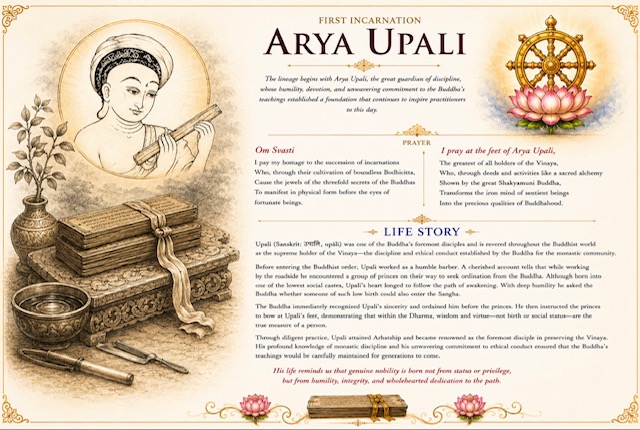
I pray at the feet of Upali,

The greatest of all holders of Vinaya,

Who with deeds and activities like an alchemy

Shown by the great Shakyamuni Buddha.

Transforms the iron mind of sentient beings

Into precious qualities of the Buddha.

upali drawing

Story of Upali, a Past Incarnate of ZaChoeje

Upali (Sanskrit उपािल upāli) was a monk, one of the chief disciples of the Buddha. The story of Rinpoche’s first.

A group of princes set out to meet Shakyamuni Buddha.  Along their way they stopped by the humble, poor, low caste barber Upali who had set up shop along side the road.  In preparation for meeting Buddha princes asked the barber to completely cut off their long hair and remove their facial hair.  Having no need for material things, the princes and their entourage offered all their possession to the lowly barber.  With the jewels and bounty the barber could buy kingdoms with what they left.  Yet, feeling their weight and seeing their radiance, Upali sensed a deeper light calling within. What he thought could be more precious than these?  Upali tied the jewels to a tree branch and left the belongings, saying softly, “Let whoever values these take them. I seek that which is beyond price.” Drawn by an unexplainable longing, he secretly followed the princes from a distance, out of sight, his heart quietly awakening with each step. It is said that Upali was an earlier incarnation of ZaChoeje Rinpoche, carrying forward through countless lifetimes the same deep devotion to truth and the wish to awaken for the benefit of others.

When Upali arrived at Buddha’s summer camp, he remained outside grove’s gathering, aware of his low birth and the caste that society said defined him. But Shariputra, one of the Buddha’s foremost disciples, saw him sitting alone and recognized the purity of his heart. He invited Upali  to come inside the grove. As Buddha began to teach, he spoke of the true equality of all beings, that no caste, wealth, or birth can bind the awakened mind. Hearing this, Upali’s heart opened completely. The light he had sought—the treasure beyond jewels—shone within him. In that moment, the barber Upali, who would one day return as ZaChoeje Rinpoche, realized the timeless truth of the Dharma: enlightenment belongs to all who seek it with sincerity, humility, and love.

Later Upali became an Arhat. He became the main disciple in knowing the rules of the order and the foremost disciple in keeping precepts.

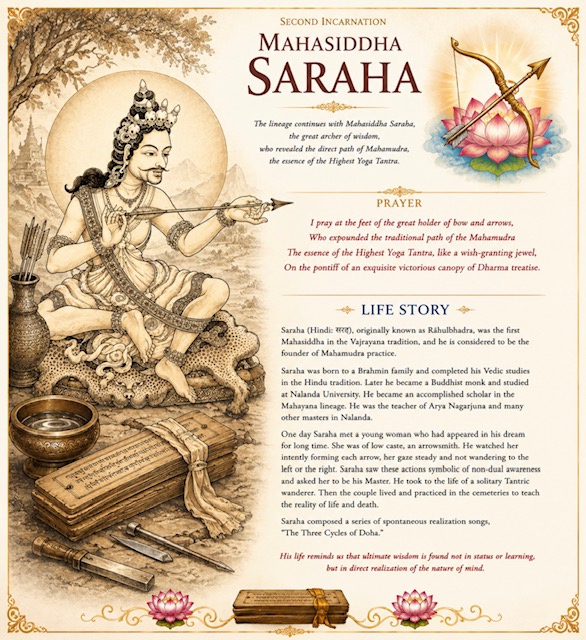
I pray at the feet of the great holder of bow and arrows,

Who expounded the traditional path of Mahamudra

The essence of the Highest Yoga Tantra, like a wish-granting jewel,

On the pontiff of an exquisite victorious canopy of Dharma treatise.

Sarahs

Second Saraha

Saraha,(Hindi: सरह) originally known as Rāhulbhadra, was the first Mahasiddha in the Vajrayana tradition, and he is considered to be the founder of Mahamudra practice.

Saraha was born to a Brahmin family and completed his Vedic studies in the Hindu tradition. Later he became a Buddhist monk and studied at Nalanda University. He became an accomplished scholar in the Mahayana lineage. He was the teacher of Arya Nagarjuna and many other masters in Nalanda.

One day Saraha met a young woman who had appeared in his dreams for a long time. She was of low caste, an arrowsmith. He watched her intently forming each arrow, her gaze steady and never wandering to the left or the right. Saraha saw these actions symbolic of non-dual awareness and asked her to be his Master. He took to the life of a solitary Tantric wanderer. Then the couple lived and practiced in cemeteries teaching the reality of life and death. Saraha composed a series of spontaneous realization songs, “The Three Cycles of Doha.”

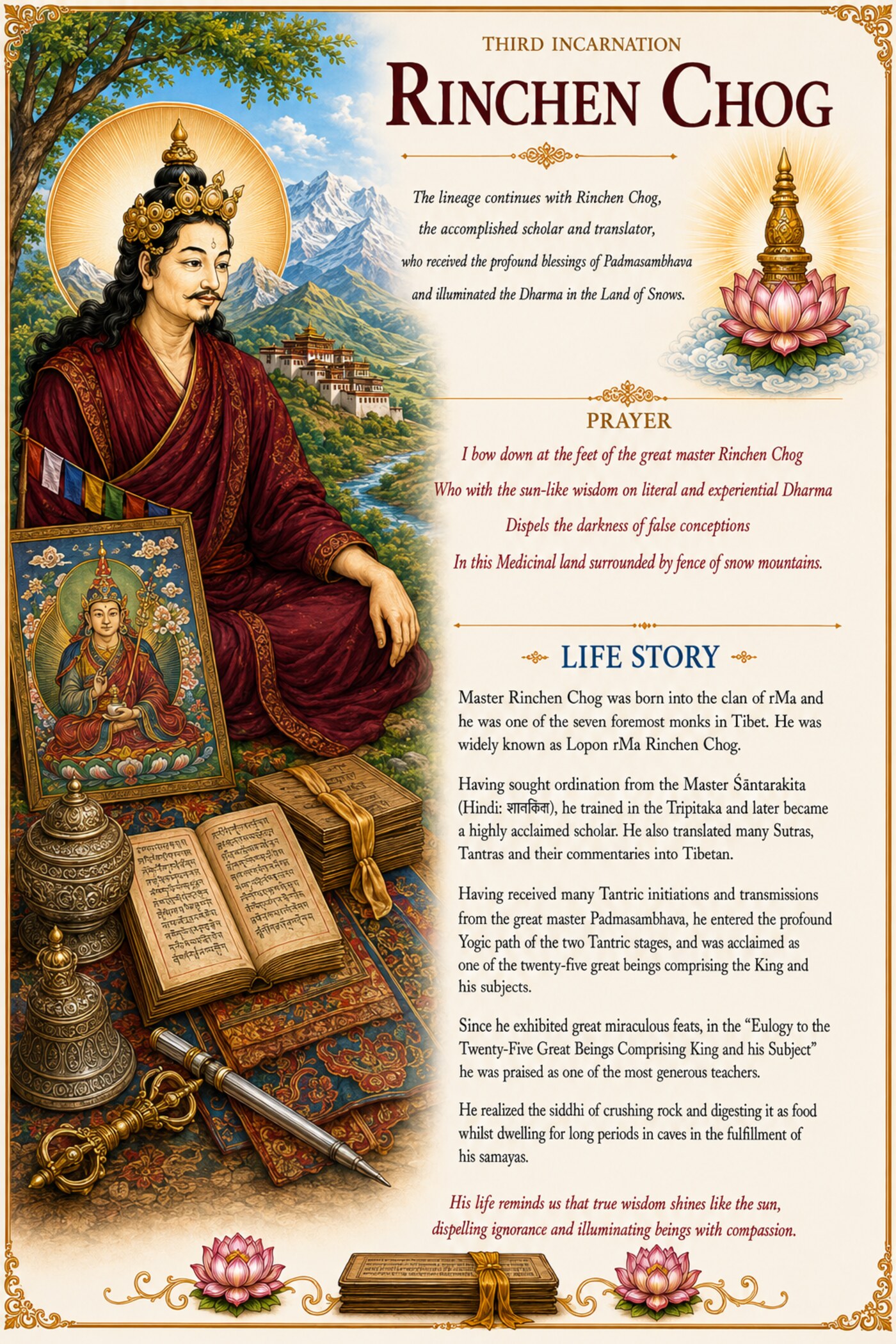
I bow down at the feet of the great master Rinchen Chog

Who with the sun-like wisdom on literal and experiential Dharma

Dispels the darkness of false conceptions

In this Medicinal land surrounded by fences of snow mountains.

Third incarnation

Master Rinchen Chog was born into the clan of rMa and he was one of the seven foremost monks in Tibet. He was widely known as Lopon rMa Rinchen Chog. Having sought ordination from the Master Śāntarak ita (Hindi: शातरित), he trained in the Tripitaka and later became a highly acclaimed scholar. He also translated many Sutras, Tantras and their commentaries into Tibetan. Having received many Tantric initiations and transmissions from the great master Padmasambhava, he entered the profound Yogic path of the two Tantric stages, and was acclaimed as one of the twenty-five great beings comprising the King and his subjects. Since he exhibited great miraculous feats, in the “Eulogy to the Twenty-Five Great Beings Comprising King and his Subject” he was praised as one of the most generous teachers. He realized the siddhi of crushing rock and digesting it as food while dwelling for long periods in caves in the fulfillment of his samayas.

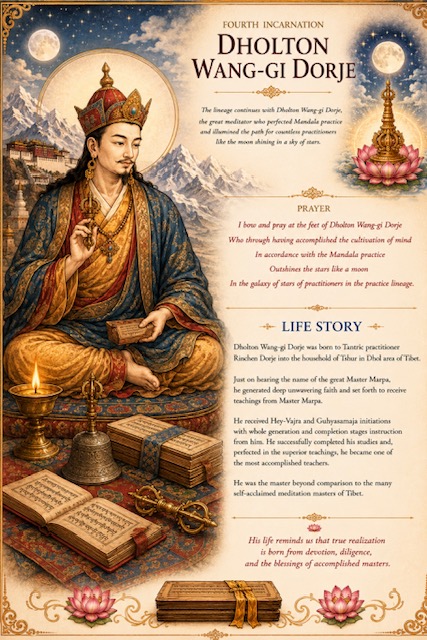
I bow and pray at the feet of Dholton Wang-gi Dorje

Who through having accomplished the cultivation of mind

In accordance with the Mandala practice

Outshines the stars like a moon

In the galaxy of stars of practitioners in the practice lineage.

Fourth incarnation

Dholton Wang-gi Dorje was born to Tantric practitioner Rinchen Dorje into the household of Tshur in Dhol area of Tibet. Just on hearing the name of the great Master Marpa, he generated deep unwavering faith and set forth to receive teachings from Master Marpa. He received Hey-Vajra and Guhyasamaja initiations with the whole generation and completion stages instruction from him. He successfully completed his studies and, perfected in the superior teachings, he became one of the most accomplished teachers. He was the master beyond comparison to the many self-acclaimed meditation masters of Tibet.

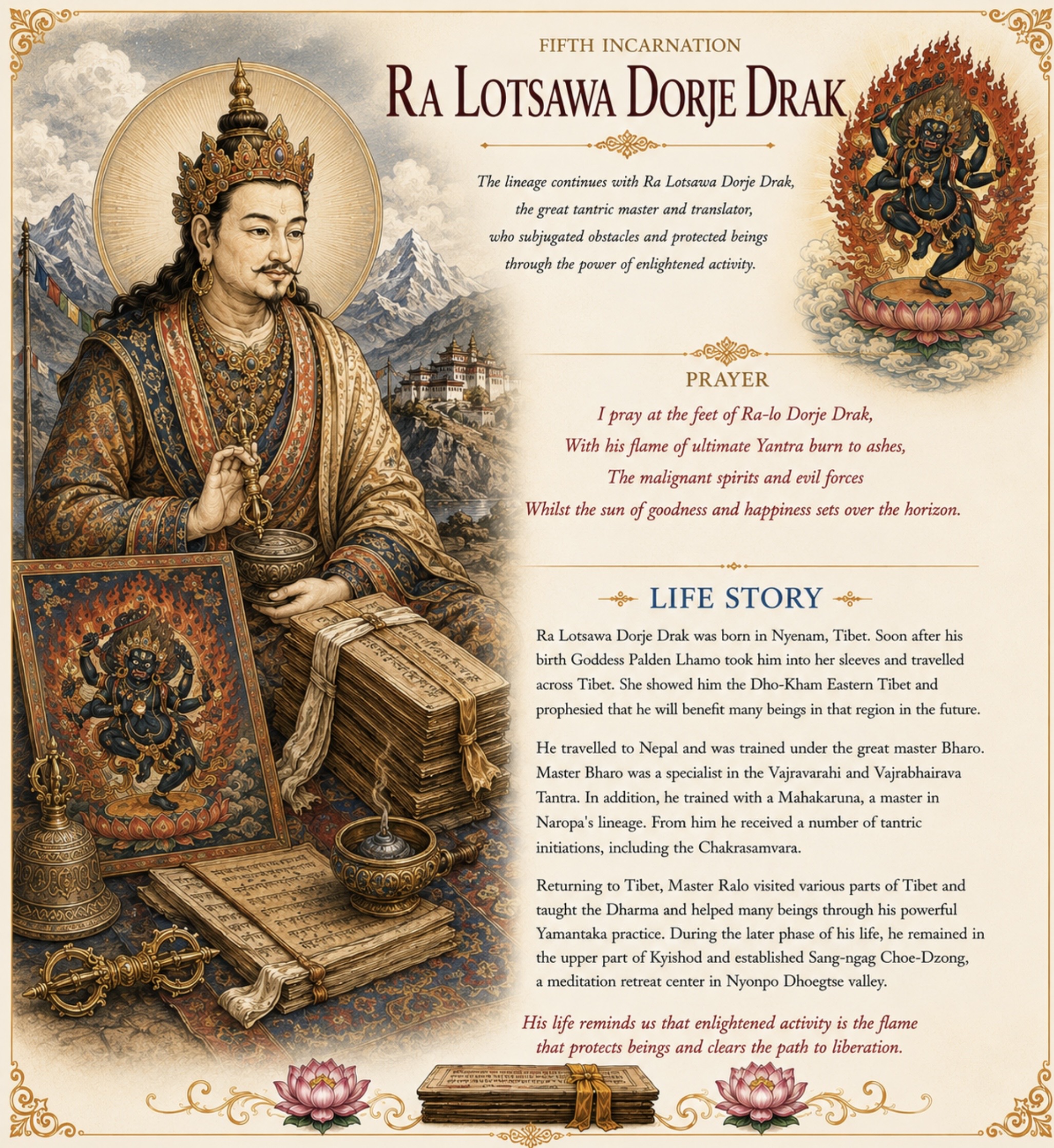
I pray at the feet of Ra-lo Dorje Drak,

With his flame of ultimate Yantra burn to ashes,

The malignant spirits and evil forces

Whilst the sun of goodness and happiness sets over the horizon.

Fifth incarnation

Ra Lotsawa Dorje Drak was born in Nyenam, Tibet. Soon after his birth Goddess Palden Lhamo took him into her sleeves and travelled across Tibet. She showed him Dho-Kham, Eastern Tibet and prophesied that he will benefit many beings in that region in the future.

He travelled to Nepal and was trained under the great master Bharo. Master Bharo was a specialist in the Vajravarahi and Vajrabhairava Tantra. In addition, he trained with a Mahakaruna, a master in Naropa's lineage. From him he received a number of tantric initiations, including Chakrasamvara.

Returning to Tibet, Master Ralo visited various parts of Tibet and taught the Dharma and helped many beings through his powerful Yamantaka practice. During the later phase of his life, he remained in the upper part of Kyishod and established Sang-ngag Choe-Dzong, a meditation retreat center in the Nyonpo Dhoegtse valley.

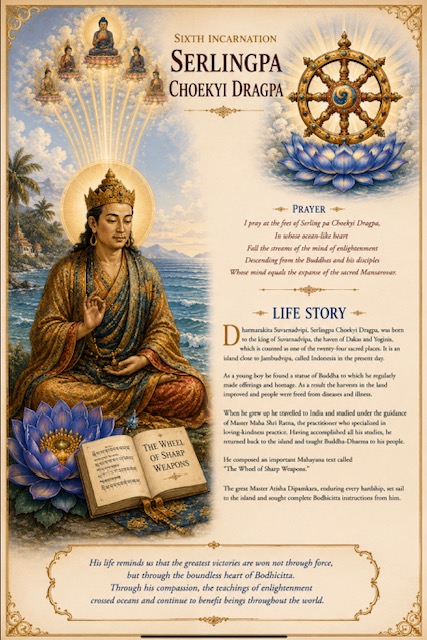
I pray at the feet of Serling pa Choekyi Dragpa,

In whose ocean-like heart

Fall the streams of the mind of enlightenment

Descending from the Buddhas and his disciples

Whose mind equals the expanse of the sacred Mansarovar.

Sixth incarnation

Dharmarak ita Suvarnadvipi, Serlingpa Choekyi Dragpa, was born to the king of Suvarnadvipa, the haven of Dakas and Yoginis, which is counted as one of the twenty-four sacred places. It is an island close to Jambudvipa, now called Indonesia. As a young boy he found a statue of Buddha to which he regularly made offerings and homage. As a result the harvests in the land improved and people were freed from diseases and illness. When he grew up he travelled to India and studied under the guidance of Master Maha Shri Ratna, the practitioner who specialized in loving-kindness practice. Having accomplished all his studies, he returned back to the island and taught Buddha-Dharma to his people. He composed an important Mahayana text called "The Wheel of Sharp Weapons." The great Master Atisha Dipamkara, enduring every hardship, set sail to the island and sought complete Bodhicitta instructions from him.

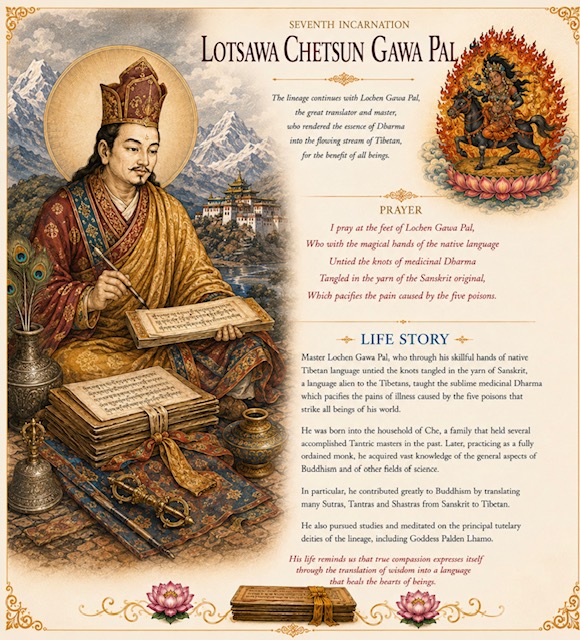
I pray at the feet of Lochen Gawa Pal,

Who with the magical hands of the native language

Untied the knots of medicinal Dharma

Tangled in the yarn of the Sanskrit original,

Which pacifies the pain caused by the five poisons.

Seventh incarnation

Master Lochen Gawa Pal, who through his skillful hands of native Tibetan language untied the knots tangled in the yarn of Sanskrit, a language alien to the Tibetans, taught the sublime medicinal Dharma which pacifies the pains of illness caused by the five poisons that strike all beings of his world. He was born into the household of Che, a family that held several accomplished Tantric masters in the past. Later, practicing as a fully ordained monk, he acquired vast knowledge of the general aspects of Buddhism and of other fields of science. In particular, he contributed greatly to Buddhism by translating many Sutras, Tantras and Shastras from Sanskrit to Tibetan. He also pursued studies and meditated on the principal tutelary deities of the lineage, including Goddess Palden Lhamo.

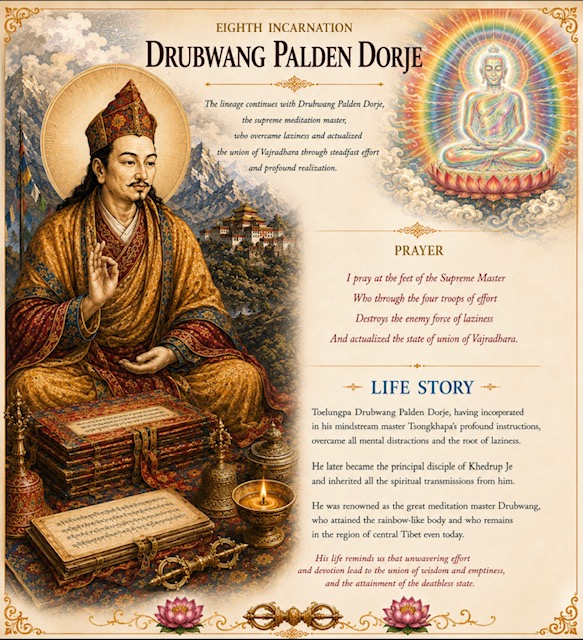
I pray at the feet of the Supreme Master

Who through the four troops of effort

Destroys the enemy force of laziness

And actualized the state of union of Vajradhara.

Eighth incarnation

Toelungpa Drubwang Palden Dorje, having incorporated in his mindstream master Tsongkhapa’s profound instructions, overcame all mental distractions and the root of laziness. He later became the principal disciple of Khedrup Je and inherited all the spiritual transmissions from him. He was renowned as the great meditation master Drubwang, who attained the rainbow-like body and who remains in the region of central Tibet even today.

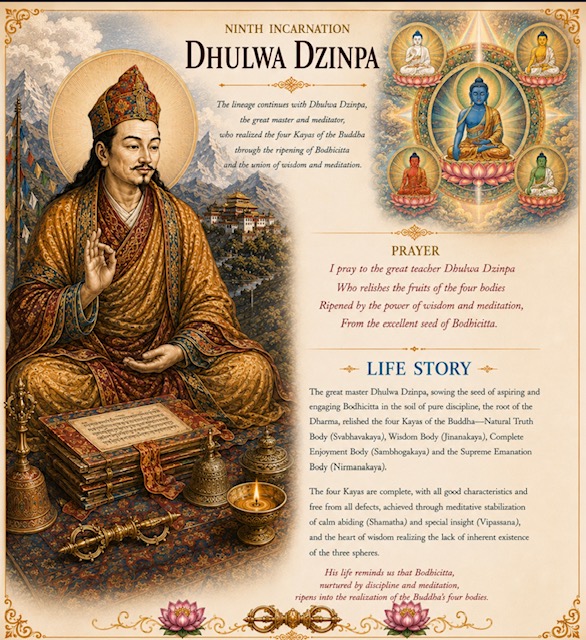
I pray to the great teacher Dhulwa Dzinpa

Who relishes the fruits of the four bodies

Ripened by the power of wisdom and meditation,

From the excellent seed of Bodhicitta.

Ninth incarnation

The great master Dhulwa Dzinpa, sowing the seed of aspiring and engaging Bodhicitta in the soil of pure discipline, the root of the Dharma, relished the four Kayas of the Buddha—Natural Truth Body (Svabhavakaya), Wisdom Body (Jinanakaya), Complete Enjoyment Body(Sambhogakaya) and the Supreme Emanation Body (Nirmanakaya). The four Kayas are complete, with all good characteristics and free from all defects, achieved through meditative stabilization of calm abiding (Shamatha) and special insight (Vipassana), and the heart of wisdom realizing the lack of inherent existence of the three spheres.

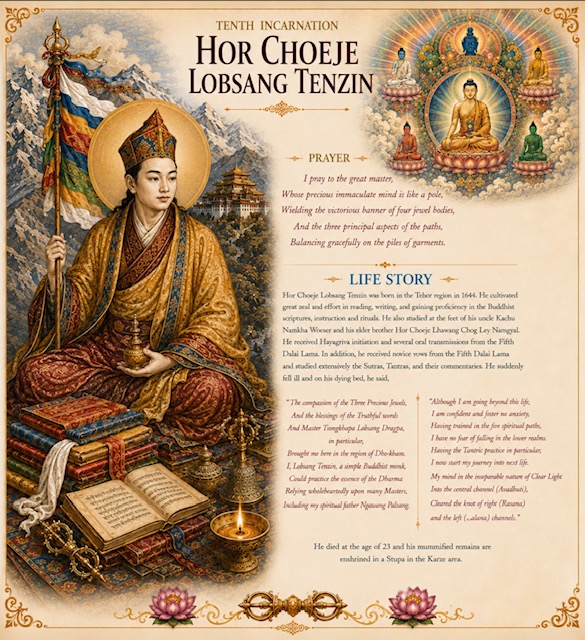
I pray to the great master,

Whose precious immaculate mind is like a pole,

Wielding the victorious banner of four jewel bodies,

And the three principal aspects of the paths,

Balancing gracefully on the piles of garments.

Tenth incarnation

Hor Choeje Losang Tenzin was born in the Tehor region in 1644. He cultivated great zeal and effort in reading, writing, and gaining proficiency in the Buddhist scriptures, instruction and rituals. He also studied at the feet of his uncle Kachu Namkha Woeser and his elder brother Hor Choeje Lhawang Chog Ley Namgyal. He received Hayagriva initiation and several oral transmissions from the Fifth Dalai Lama. In addition, he received novice vows from the Fifth Dalai Lama and studied extensively the Sutras, Tantras, and their commentaries. He suddenly fell ill and on his dying bed, he said,

"The compassion of the Three Precious Jewels, And the blessings of the Truthful words And Master Tsongkhapa Lobsang Dragpa, in particular, Brought me here in the region of Dho-kham. I, Lobsang Tenzin, a simple Buddhist monk, Could practice the essence of the Dharma Relying wholeheartedly upon many Masters, Including my spiritual father Ngawang Palzang.

"Although I am going beyond this life, I am confident and foster no anxiety, Having trained in the five spiritual paths, I have no fear of falling in the lower realms. Having the Tantric practice in particular, I now start my journey into next life. My mind in the inseparable nature of Clear Light Into the central channel (Avadhuti), Cleared the knot of right (Rasana) and the left (Lalana) channels."

He died at the age of 23 and his mummified remains are enshrined in a Stupa in the Karze area.

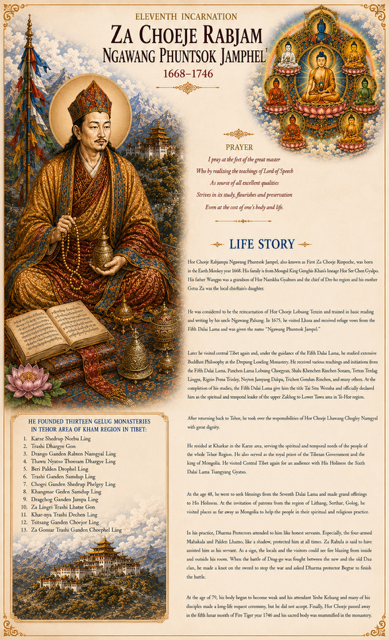
I pray at the feet of the great master

Who by realizing the teachings of the Lord of Speech

As source of all excellent qualities

Strives in its study, flourishes and preservation

Even at the cost of one’s body and life.

Rinpoche 3

Eleventh incarnation

Hor Choeje Rabjampa Ngawang Phuntsok Jampel, also known as First Za Choeje Rinpoche, was born in the Earth Monkey year 1668 . His family is from Mongol King Genghis Khan's lineage Hor Ser Chen Gyalpo. His father Wangpo was a grandson of Hor Namkha Gyaltsen and the chief of Dre-ho region and his mother Getsa Za was the local chieftain's daughter.

He was considered to be the reincarnation of Hor Choeje Lobsang Tenzin and trained in basic reading and writing by his uncle Ngawang Palsang. In 1675, he visited Lhasa and received refuge vows from the Fifth Dalai lama and was given the name “Ngawang Phuntsok Jampel.”

Later he visited central Tibet again and, under the guidance of the Fifth Dalai Lama, he studied extensive Buddhist Philosophy at the Drepung Loseling Monastery. He received various teachings and initiations from the Fifth Dalai Lama, Panchen Lama Lobsang Choegyan, Shalu Khenchen Rinchen Sonam, Terton Terdag Lingpa, Rigzin Pema Trinley, Neyten Jamyang Dakpa, Trichen Gendun Rinchen, and many others. At the completion of his studies, the Fifth Dalai Lama give him the title Tai Situ Wensha and officially declared him as the spiritual and temporal leader of the upper Zakhog to Lower Tawu area in Te-Hor region.

After returning back to Tehor, he took over the responsibilities of Hor Choeje Lhawang Chogley Namgyal with great dignity.

He founded Thirteen Gelug monasteries in the Tehor area of the Kham Region in Tibet: 1-Karze Shedrup Norbu Ling, 2-Trashi Dhargye Gon, 3- Drango Ganden Rabten Namgyal Ling, 4-Thawu Nyatso Thoesam Dhargye Ling, 5-Beri Palden Dro phel Ling, 6- Trashi Ganden Samdup Ling, 7- Chogri Ganden Shedrup Phelgey Ling, 8- Khangmar Geden Samdup Ling, 9- Dragchog Ganden Jampa Ling, 10- Za Lingri Trashi Lhatse Gon, 11- Khar-nya Trashi Dechen Ling, 12- Tsitsang Ganden Choejor Ling, 13- Za Gonsar Trashi Ganden Choephel Ling.

He resided at Kharkar in the Karze area, serving the spiritual and temporal needs of the people of the whole Tehor Region. He also served as the royal priest of the Tibetan Government and the king of Mongolia. He visited Central Tibet again for an audience with His Holiness the Sixth Dalai Lama Tsangyang Gyatso.

At the age 48, he went to seek blessings from the Seventh Dalai Lama and made grand offerings to His Holiness. At the invitation of patrons from the region of Lithang, Serthar, Golog, he visited places as far away as Mongolia to help the people in their spiritual and religious practice.

In his practice, Dharma Protectors attended to him like honest servants. Especially, the four-armed Mahakala and Palden Lhamo, like a shadow, protected him at all times. Za Rahula is said to have assisted him as his servant. As a sign, the locals and the visitors could see fire blazing from inside and outside his room. When the battle of Drag-go was fought between the new and the old Dza clan, he made a knot out of a long, sturdy sword to stop the war and asked Dharma protector Begtse to finish the battle.

At the age of 79, his body began to become weak and his attendant Yeshe Kelsang and many of his disciples made a long-life request ceremony, but he did not accept. Finally, Hor Choeje passed away in the fifth lunar month of Fire Tiger year 1746 and his sacred body was mummified in the monastery

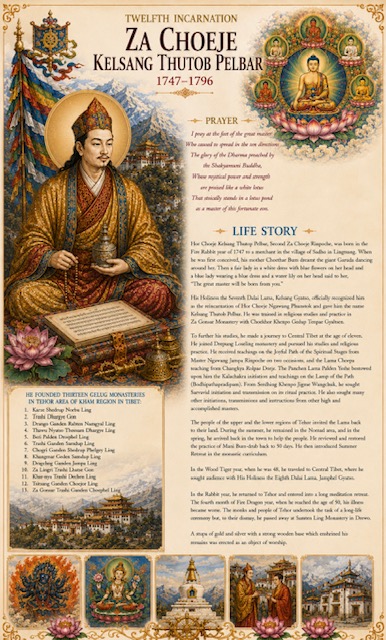
I pray at the feet of the great master

Who caused to spread in the ten directions

The glory of the Dharma preached by the Shakyamuni Buddha,

Whose mystical power and strength are praised like a white lotus

That stoically stands in a lotus pond as a master of this fortunate eon.

Rinpoche 5

Twelth incarnation

Hor Choeje Kelsang Thutop Pelbar, Second Za Choeje Rinpoche, was born in the Fire Rabbit year of 1747 to a merchant in the village of Sadho in Lingtsang. When he was first conceived, his mother Choethar Bum dreamt the giant Garuda dancing around her. Then a fair lady in a white dress with blue flowers on her head and a blue lady wearing a blue dress and a water lily on her head said to her, “The great master will be born from you.”

His Holiness the Seventh Dalai Lama, Kelsang Gyatso, officially recognized him as the reincarnation of Hor Choeje Ngawang Phunstok and gave him the name Kelsang Thutob Pelbar. He was trained in religious studies and practice in Za Gonsar Monastery with Choekhor Khenpo Gedup Tenpae Gyaltsen.

To further his studies, he made a journey to Central Tibet at the age of eleven. He joined Drepung Loseling monastery and pursued his studies and religious practice. He received teachings on the Joyful Path of the Spiritual Stages from Master Ngawang Jampa Rinpoche on two occasions, and the Lama Choepa teaching from Changkya Rolpae Dorje. The Panchen Lama Palden Yeshe bestowed upon him the Kalachakra initiation and teachings on the Lamp of the Path (Bodhipathapradipam). From Serdhing Khenpo Jigme Wangchuk, he sought Sarvavid initiation and the transmission on its ritual practice. He also sought many other initiations, transmissions and instructions from other high and accomplished masters.

The people of the upper and the lower regions of Tehor invited the Lama back to their land. During the summer, he remained in the Nomad area, and in the spring, he arrived back in the town to help the people. He reviewed and restored the practice of Mani Bum-drub back to 50 days. He then introduced Summer Retreat in the monastic curriculum.

In the Wood Tiger year, when he was 48, he traveled to Central Tibet, where he sought audience with His Holiness the Eighth Dalai Lama, Jamphel Gyatso. In the Rabbit year, he returned to Tehor and entered into a long meditation retreat. The fourth month of Fire Dragon year, when he reached the age of 50, an illness he was suffering became worse. The monks and people of Tehor undertook the task of a long-life ceremony but, to their dismay, he passed away at Samten Ling Monastery in Drewo. A stupa of gold and silver with a strong wooden base which enshrined his remains was erected as an object of worship.

Rinpoche 4

Thirteenth incarnation

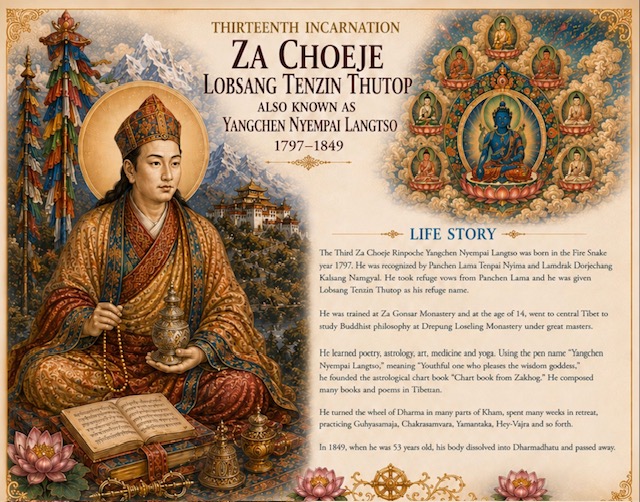
Thirteenth Incarnation: Za Choeje Lobsang Tenzin Thutop, also known as Yangchen Nyempai Langtso 1797-1849 The Third Za Choeje Rinpoche Yangchen Nyempai Langtso was born in the Fire Snake year 1797. His family lineage came from Tramo Lingtsang, a noble family Hordhatsang. His father's name was Kalsang Phuntsok and his mother was Pema Tso. He was recognized by Panchen Lama Tenpai Nyima and Lamdrak Dorjechang Kalsang Namgyal. He took refuge vows from the Panchen Lama and he was given Lobsang Tenzin Thutop as his refuge name.

He was trained to read and write and learned ritual practices at Za Gonsar Monastery. At the age of 14, in the Iron Horse year 1810, he went to central Tibet to further his studies in Buddhist philosophy. He joined Drepung Loseling Monastery and studied under the guidance of Karze Geshe Lobsang Tashi, Tsetsang Geshe Tsewang Rabten, Geshe Ngawang Choephel and Rongpo Khenchen Lobsang Phuntsok. At the age of 18, with permission from His Holiness and Panchen Lama, he returned to Tehor.

He learned poetry, astrology, art, medicine and yoga from various teachers in central Tibet. He used “Yangchen Nyempai Langtso” as his pen name which means “Youthful one who pleases the wisdom goddess.” His astrological readings were so accurate that he founded the astrological chart book called “Chart book from Zakhog." He composed many books and poems in Tibetan and the original former HorChoeje's lineage story was written by him.

As requested by many fortunate spiritual seekers and spiritual masters, he turned the wheel of Dharma in many parts of Kham. He spent many weeks in retreat, practicing Guhyasamaja, Chakrasamvara, Yamantaka, Hey-Vajra and so forth. In 1849, when he was 53 years old, his body dissolved into Dharmadhatu and passed away.

Rinpoche 6

Fourteenth incarnation

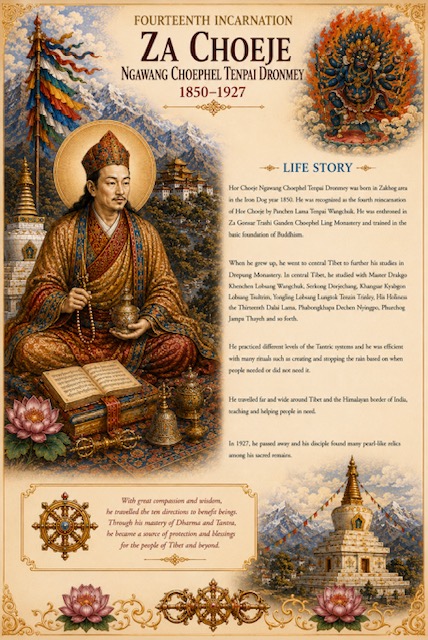
Fourteenth Incarnation: Za Choeje Ngawang Choephel Tenpai Dronmey 1850-1927 Hor Choeje Ngawang Choephel Tenpai Dronmey was born in Zakhog area in the Iron Dog year 1850. He was recognized as the fourth reincarnation of Hor Choeje by Panchen Lama Tenpai Wangchuk. He was enthroned in Za Gonsar Trashi Ganden Choephel Ling Monastery and trained in the basic foundation of Buddhism. When he grew up, he went to central Tibet to further his studies in Drepung Monastery. In central Tibet, he studied with Master Drakgo Khenchen Lobsang Wangchuk, Serkong Dorjechang, Khangsar Kyabgon Lobsang Tsultrim, Yongling Lobsang Lungtok Tenzin Trinley, His Holiness the Thirteenth Dalai Lama, Phabongkhapa Dechen Nyingpo, Phurchog Jampa Thayeh and so forth. He practiced different levels of the Tantric systems and he was efficient with many rituals such as creating and stopping the rain based on when people needed or did not need it.

He travelled far and wide around Tibet and the Himalayan border of India, teaching and helping people in need. In 1927, he passed away and his disciple found many pearl-like relics found from his cremation.

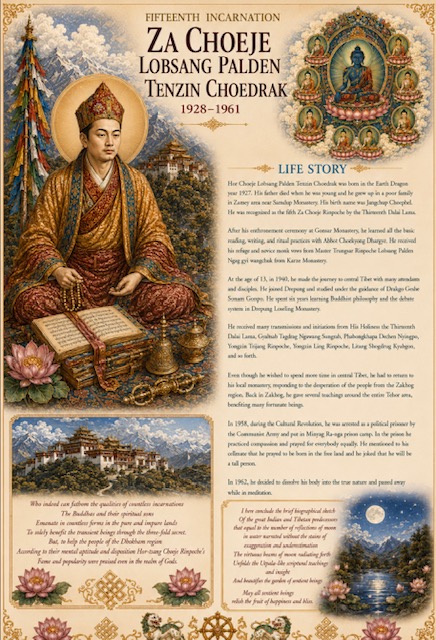
Fifteenth Incarnation: Za Choeje Lobsang Palden Tenzin Choedrak 1928-1961 Hor Choeje Lobsang Palden Tenzin Choedrak was born in the Earth Dragon year 1927. His father died when he was young and he grew up in a poor family in Zamey area near Samdup Monastery. His birth name was Jangchup Choephel. He was recognized as the fifth Za Choeje Rinpoche by the Thirteenth Dalai Lama. After his enthronement ceremony at Gonsar Monastery, he learned all the basic reading, writing, and ritual practices with Abbot Choekyong Dhargye. He received his refuge and novice monk vows from Master Trungsar Rinpoche Lobsang Palden Ngag gyi wangchuk from Karze Monastery.

At the age of 13, in 1940, he made the journey to central Tibet with many attendants and disciples. He joined Drepung and studied under the guidance of Drakgo Geshe Sonam Gonpo. He spent six years learning Buddhist philosophy and the debate system in Drepung Loseling Monastery. He received many transmissions and initiations from His Holiness the Thirteenth Dalai Lama, Gyaltsab Tagdrag Ngawang Sungrab, Phabongkhapa Dechen Nyingpo, Yongzin Trijang Rinpoche, Yongzin Ling Rinpoche, Litang Shogdrug Kyabgon, and so forth.

Even though he wished to spend more time in central Tibet, he had to return to his local monastery, responding to the desperation of the people from the Zakhog region. Back in Zakhog, he gave several teachings around the entire Tehor area, benefiting many fortunate beings.

In 1958, during the Cultural Revolution, he was arrested as a political prisoner by the Communist Army and put in Minyag Ra-nga prison camp. In the prison he practiced compassion and prayed for everybody equally. He mentioned to his cellmate that he prayed to be born in the free land and he joked that he will be a tall person. In 1962, he decided to dissolve his body into the true nature and passed away while in meditation.

Closing words on incarnation

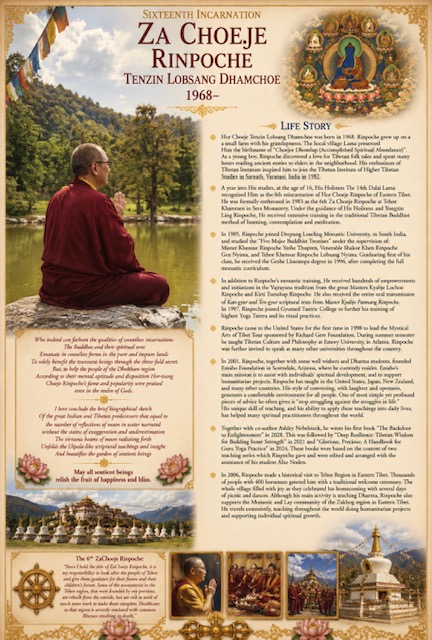
Who indeed can fathom the qualities of countless incarnations The Buddhas and their spiritual sons Emanate in countless forms in the pure and impure lands To solely benefit the transient beings through the three-fold secret. But, to help the people of the Dhokham region According to their mental aptitude and disposition Hor-tsang Choeje Rinpoche's Fame and popularity were praised even in the realm of Gods.

I here conclude the brief biographical sketch Of the great Indian and Tibetan predecessors that equal to the number of reflections of moon in water narrated without the stains of exaggeration and underestimation The virtuous beams of moon radiating forth Unfolds the Utpala-like scriptural teachings and insight And beautifies the garden of sentient beings

May all sentient beings relish the fruit of happiness and bliss.

lotus border

Give to Sustain the Teachings

Your donation keeps retreats, sacred art, and community outreach available to practitioners worldwide.

Donate to Emaho

Contributions are tax-deductible where permitted by law.

🪷

Subscribe to our Newsletter

Receive Emaho news, invitations to special events, and announcements related to our ongoing projects.

Connect with Emaho

Join us online for teachings, community updates, and moments of inspiration from the sangha.

© 2025 Emaho Foundation. All Rights Reserved.
Emaho is a 501(c)3 non-profit.