Medicine Buddha
Deep blue like lapis lazuli, holding a bowl of healing nectar. His mudra signifies granting boons and healing.
Tibetan Buddhism
The Diamond Vehicle. The Thunderbolt Path. A teaching for both newcomers to Buddhism and longtime practitioners.
In Tibetan Buddhism, deity practice is one of the most profound and often misunderstood aspects of the Vajrayana path. The word "deity" does not refer to worshipping an external god in the ordinary sense. Rather, these enlightened forms, such as Chenrezig, Green Tara, Medicine Buddha, or Vajrasattva, are symbolic expressions of awakened qualities already present within every being, our Buddha nature. Compassion, wisdom, fearlessness, healing, clarity, and loving awareness are given sacred form so we can gradually recognize these qualities within our own mind and heart.
The roots of deity practice stretch back thousands of years. The great Mahasiddhas and realized masters transmitted Vajrayana teachings that flourish in Tibet today. Through visualization, mantra recitation, meditation, and devotion, we train ourselves to see beyond ordinary limitation. Instead of endlessly reinforcing thoughts such as "I am angry," "I am afraid," or "I am incomplete," deity practice gently introduces a new possibility: to know our deepest nature is already pure and compassionate.
In this way, Vajrayana is often called the "path of transformation": transforming confusion into wisdom, attachment into compassion, and ordinary perception into sacred outlook.
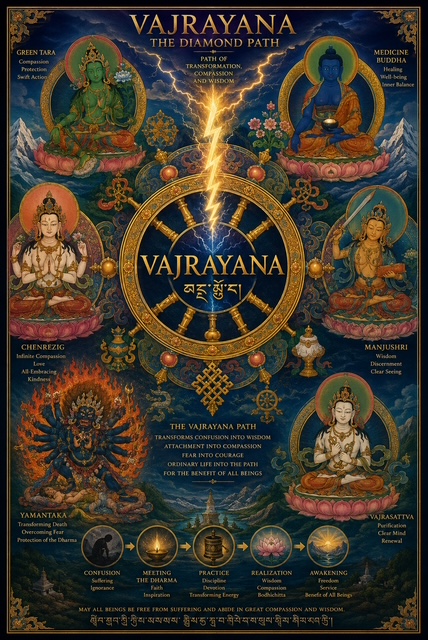
The benefits of deity practice are vast. On a practical level, it helps calm our mind, strengthen concentration, open our heart, and cultivate emotional resilience. Mantra and visualization become powerful support during times of anxiety, grief, illness, and uncertainty. Over time, we often feel more connected, more compassionate toward others, and less trapped by habitual patterns of fear and self-centeredness.
On a deeper level, deity practice is designed to help us recognize what Tibetan Buddhism calls our Buddha-nature: the luminous, compassionate awareness that exists within all beings. The deity becomes a mirror reflecting our own awakened potential. Slowly, through sincere practice, the separation between ourselves and enlightenment begins to soften. What once seemed distant or impossible becomes intimate and alive in our everyday life: in how we speak, how we love, how we help others, and how we meet the world with greater wisdom and compassion.
Vajrayana Buddhism, often called the "Diamond Vehicle" or the "Thunderbolt Path," is considered one of the most profound and transformative streams within the Buddhist tradition. Rooted in the Mahayana teachings of compassion and wisdom, Vajrayana flourishes in Tibet, where it is woven into every aspect of spiritual life: meditation, philosophy, art, ritual, music, poetry, and daily practice.
While all Buddhist paths seek liberation from suffering and awakening for the benefit of others, Vajrayana is unique in its emphasis on transformation rather than renunciation alone. Instead of rejecting the complexities of human experience, Vajrayana teaches that even confusion, emotion, desire, and difficulty can become fuel for awakening when approached with wisdom and skillful means.
What makes Vajrayana especially distinctive is its sacred view of reality. In many Buddhist traditions, practitioners gradually cultivate qualities such as compassion, patience, mindfulness, and wisdom over countless lifetimes. Vajrayana agrees with this gradual path, yet also introduces a more direct and accelerated approach. Through deity yoga, mantra, visualization, subtle body practices, meditation, devotion to the master, and profound philosophical understanding, we train to recognize that our true nature is already inseparable from enlightenment itself. We are not trying to "become" a Buddha someday far away ; rather, we learn to uncover the awakened nature already present beneath layers of confusion, habitual thinking, and ignorance.
One of the most inspiring aspects of Vajrayana is its ability to transform ordinary life into spiritual practice. Sound becomes mantra. Movement becomes sacred gesture. Our breath becomes meditation. Even difficult emotions are not enemies to destroy, but energies that can be transformed into wisdom and compassion. This is why Vajrayana symbolism is often vivid and mysterious: wrathful deities, sacred mandalas, ritual instruments, bells, vajras, mudras, and intricate visualizations all point toward a radical shift in perception: the world is not separate from awakening when seen clearly.
At the heart of Vajrayana is bodhichitta: the sincere wish to awaken for the benefit of all beings. Without compassion, the practices are considered incomplete. The goal is never spiritual achievement for oneself alone, but the cultivation of a courageous and compassionate heart capable of helping others more deeply and skillfully. Vajrayana is both mystical and deeply practical. It invites us not to escape the world, but to engage it with greater love, clarity, wisdom, and fearlessness.
Vajrayana feels uniquely alive and experiential. It speaks not only to our intellect, but also to our imagination, the emotions, the body, and the deeper symbolic layers of our human experience. Its practices are designed to awaken the whole person. Beneath the rich rituals and sacred imagery is a remarkably simple truth taught by Buddha: that freedom, compassion, and wisdom are possible, and that our deepest nature is far more luminous than we usually believe.
The practices we offer at the Center, each a doorway into the awakened qualities described above.
Deep blue like lapis lazuli, holding a bowl of healing nectar. His mudra signifies granting boons and healing.
Endowed for her swift salvation of sentient beings, Green Tara responds immediately to pleas for help. Her right hand forms the generosity mudra, protecting beings from fear and obstacles ; her left holds a delicate blue lotus.
Golden-yellow brilliance, wielding a flaming sword of wisdom in his right hand and a scripture resting on a lotus in his left.
White in appearance, embodying compassion. Two main hands clasped at the heart in the gesture of prayer, holding a wish-fulfilling jewel.
Fierce and dark, blazing with wrathful compassion. Crowned with skulls and bearing multiple arms, embodying the destruction of death itself.
Your donation keeps retreats, sacred art, and community outreach available to practitioners worldwide.
Contributions are tax-deductible where permitted by law.
Receive Emaho news, invitations to special events, and announcements related to our ongoing projects.
We respect your privacy and do not use cookies. Your preferences are stored locally on your device.
© 2026 Emaho Foundation. All Rights Reserved. 501(c)(3) nonprofit. Privacy Policy Terms of Use Accessibility WCAG 2.1 AA
 Facebook
 YouTube