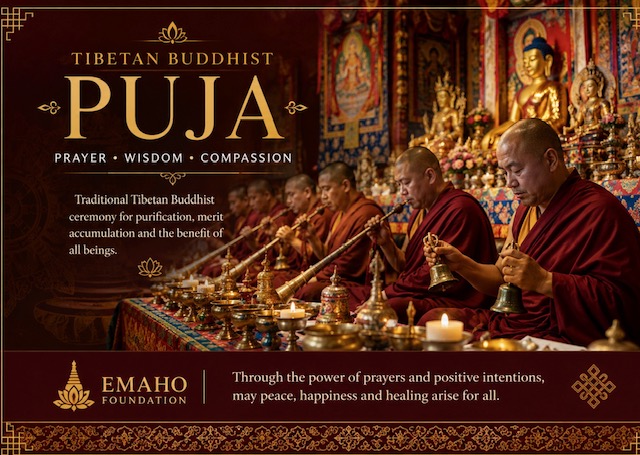
Puja
A Tibetan Buddhist puja is far more than a ceremony. It is a living spiritual technology refined over centuries by realized masters who deeply understood the relationship between mind, intention, symbolism, compassion, wisdom, and the unseen interdependence of life itself. To someone unfamiliar with Tibetan Buddhism, a puja may first appear mysterious — filled with chanting, bells, drums, incense, elaborate offerings, sacred images, and ancient Tibetan prayers. Yet beneath the outer beauty lies something profoundly practical: the transformation of the human mind and heart.
The Tibetan word often translated as “puja” comes from the Sanskrit term pūjā, meaning “offering,” “honoring,” or “devotional practice.” In Tibetan Buddhism, a puja is a sacred ritual designed to create positive conditions for awakening, healing, purification, protection, compassion, wisdom, and the benefit of all beings. It is not simply symbolic worship. It is considered an active method for transforming consciousness and cultivating enlightened qualities.
History and roots
Historically, pujas emerged from the great Indian Buddhist universities such as Nalanda and Vikramashila, where meditation, philosophy, ritual arts, mantra, and yogic practices evolved together. As Buddhism entered Tibet beginning in the 7th century, Indian Buddhist masters such as Padmasambhava, Shantarakshita, and Atisha brought ritual systems that were then preserved and expanded within Tibetan culture. Over centuries, Tibet became a vast treasury of Buddhist ritual traditions. The Tibetan people developed extraordinarily sophisticated ceremonial forms designed to support both monastic and lay practitioners in every aspect of life.
To understand a puja, it helps to understand an essential principle in Mahayana and Vajrayana Buddhism: the mind is deeply influenced by environment, sound, intention, visualization, symbolism, and collective aspiration. A puja works with all of these simultaneously. Chanting sacred texts calms and redirects our mind. Visualizations cultivate enlightened qualities. Offerings weaken attachment and strengthen generosity. Ritual instruments create rhythm and focus. Sacred images remind us of our own Buddha nature. The gathering of practitioners creates a field of collective intention and compassion.
Every outer ritual mirrors an inner transformation
The lighting of a lamp symbolizes the illumination of wisdom dispelling ignorance. Incense represents ethical discipline and the fragrance of virtue. Water bowl offerings symbolize generosity free from attachment. Flowers remind us of impermanence and beauty. Bells represent wisdom realizing emptiness. The vajra symbolizes compassion and indestructible awakened awareness. Even the arrangement of offerings on an altar reflects profound philosophical teachings about interdependence and purity.
One of the most misunderstood aspects of puja in the West is the relationship between ritual and desired outcomes. In Tibetan Buddhism, rituals are not viewed as magical commands imposed on reality. Rather, they are methods for creating causes and conditions. Buddhism teaches that experiences arise due to karma and interdependent causes. A puja helps gather beneficial conditions through intention, virtue, prayer, mantra, concentration, offerings, and compassionate motivation.
Different pujas for different purposes
A Medicine Buddha puja focuses on healing — physically, emotionally, mentally, and spiritually. Sacred images of Medicine Buddha are displayed, with blue colors, healing mantras, medicinal substances, and blessed saffron water. The atmosphere is often calm, compassionate, and restorative. The goal is not only curing disease, but addressing the deeper causes of suffering and imbalance within our mind itself.
A Green Tara puja invokes the swift compassionate activity of Tara, the female Buddha associated with protection, fearlessness, wisdom, and compassionate action. People often request Tara pujas during times of uncertainty, obstacles, fear, travel, emotional distress, or major life transitions. Green Tara represents enlightened compassion in motion — immediate responsiveness to suffering.
Chenrezig pujas center on compassion itself. Chenrezig, known in Sanskrit as Avalokiteshvara, embodies the infinite compassion of all Buddhas. The mantra Om Mani Padme Hum is perhaps the most beloved mantra in Tibetan Buddhism. During these pujas, we cultivate loving-kindness, compassion, forgiveness, and the sincere wish to relieve suffering for all beings.
Vajrasattva pujas focus on purification. In Buddhism, purification does not mean guilt or punishment. Rather, it refers to cleansing obscurations, harmful patterns, emotional heaviness, confusion, and negative karmic imprints clouding the natural clarity of our mind. Vajrasattva practice is deeply psychological and spiritual, encouraging honesty, accountability, healing, and renewal.
Protector pujas, such as those dedicated to Mahakala or Palden Lhamo, are often misunderstood in the West because their imagery can appear fierce. Yet these practices are not about aggression. Fierce enlightened forms symbolize wisdom and compassion powerful enough to cut through ignorance, ego-clinging, obstacles, and destructive tendencies.
Long life pujas are offered for great spiritual teachers or for individuals facing illness or fragility. These ceremonies focus on strengthening life force, vitality, merit, and harmonious conditions for a meaningful and beneficial life.
Tormas, merit, and dedication
Some pujas are extensive and others are short. Some are performed by monastics; others are open community gatherings. Some involve elaborate sand mandalas, tormas (ritual sculptures made of butter, yogurt, and roasted barley flour). Other pujas may simply involve chanting, meditation, offerings, and quiet prayer.
Tormas themselves hold profound symbolism. These carefully crafted ritual offerings represent transformed consciousness and generosity. In ancient Tibet, where resources were often scarce, creating beautiful offerings from simple ingredients became an act of devotion and sacred imagination. The outer torma symbolizes offering beauty and nourishment to enlightened beings; inwardly it represents transforming attachment and ego into wisdom and compassion.
In Buddhism, merit refers to positive spiritual energy generated through wholesome actions motivated by compassion, wisdom, and generosity. Merit is not a reward system. Rather, it is the natural result of actions aligned with awakening and kindness. Participating in a puja — making offerings, sponsoring prayers, chanting sincerely, helping prepare the altar, supporting the sangha, or dedicating prayers for others — is believed to create beneficial conditions for both oneself and all beings.
Equally important is the dedication of merit. All pujas conclude with prayers dedicating the goodness generated toward the welfare and awakening of all beings. This reflects the idea that spiritual practice is never solely for oneself. Compassion expands outward infinitely.
Encountering puja for the first time
For newcomers in the West, ritual can initially feel unfamiliar. Western culture often prioritizes intellectual understanding, efficiency, and visible results, while Tibetan Buddhism embraces symbolism, layered meaning, sacred art, sound, devotion, and contemplative experience. Yet many people discover that pujas reach parts of our human heart untouched by ordinary thinking.
One does not need to understand every word of Tibetan chanting to benefit. Much like sacred music, ritual can communicate beyond conceptual language. The atmosphere of a puja — the rhythmic chanting, incense, bells, drums, candles, visual beauty, silence, compassion, and collective aspiration — creates a direct felt experience of calmness, reverence, interconnectedness, and inner spaciousness.
At its deepest level, a puja reminds us of something ancient yet urgently needed in modern life: sacred spaces where the heart softens, the mind becomes quieter, compassion expands, and life is approached with greater humility and awareness. In Tibetan Buddhism, ritual is not separate from wisdom. Ritual becomes wisdom in motion.
A puja is ultimately an invitation — to pause, to remember our deepest nature and compassion, and to engage consciously in creating less suffering and more awakening in the world and throughout the universe. Tibetan Buddhist pujas have survived over thousands of years — not merely as cultural ceremonies, but as living pathways of healing, transformation, devotion, wisdom, and compassionate activity for the benefit of all beings.
Geshe Namgyal Sangpo — our resident ritual master
We are extraordinarily fortunate at Emaho to have our resident teacher, Geshe Namgyal Sangpo, who is not only a deeply trained Buddhist monk, but also a highly trained ritual master within the ancient Tibetan monastic tradition. In the great monasteries of Tibet and South India, ritual training is considered both an art and a profound spiritual discipline requiring years of memorization, study, precision, concentration, and understanding. Every detail within a puja — the melodies, chants, mudras, visualizations, offering arrangements, sacred instruments, timing, and ritual sequence — carries symbolic and spiritual significance refined through centuries of lineage transmission.
Geshe-la’s extensive training assures our community that each puja is performed with great care, authenticity, precision, and heartfelt intention according to the traditional methods preserved within Tibetan Buddhism. Having a qualified ritual master perform prayers and ceremonies on behalf of individuals, families, the community, and all sentient beings is considered an immense blessing within Tibetan culture. Geshe-la has been trained in hundreds of pujas and sacred ritual forms, each designed to cultivate specific beneficial conditions such as healing, purification, protection, long life, wisdom, compassion, prosperity, removing obstacles, and spiritual growth. At Emaho, we offer explanations of many of these pujas so we better understand not only the outer ritual itself, but the deeper meaning, purpose, and compassionate intention behind each sacred practice.

 Facebook
 YouTube